miércoles, 9 de octubre de 2013

ACTIVIDAD

ACTIVIDAD  CON SCANNING

1-      ¿Cuál fue la fecha del movimiento?
1840
2-      ¿Cuál fue el surgimiento del realismo?
Revolución 1848
3-      ¿Qué imperio estaba?
Napoleón III
4-      ¿Qué artista hizo una declaración?
Gustave Courbet
5-      ¿Cuándo fueron las primeras fechas de exposición en los Salones de Paris?
1849 y de 1850 al 1851
6-      ¿Dónde se expuso la muestra privada de Courbet?
Pavillon du Réalisme
7-      ¿Cuál fue la fecha de la exposición de Millet en el Salon?
1857
8-      ¿Cuáles son los herederos del legado realista?
Eduoard Manet y los Impresionistas

ACTIVIDAD CON SKIMMING

1-      ¿De qué se trata el movimiento realista?
Tratan de dar una visión real y objetiva de la vida contemporánea, realizan representaciones de la vida cotidiana de la clase obrera, registrando la realidad de la vida en especial de la gente humilde, valorándolos de esta forma.
2-      ¿Quién fue Courbet?
Fue el principal defensor del realismo, retrataba la gente común de su lugar natal, en escalas monumentales, lo cual fue interpretado como amenaza política, ya que su obra se consideraba anti-autoritaria
3-      ¿Qué técnica utilizo Courbet en su obra?
Evito lo academicista para desarrollar un estilo deliberadamente simple, basada en el imaginario popular. Para lo cual así irrumpe las reglas convencionales de la escale y la perspectiva
4-      ¿Cuál fue el otro artista que realizó este tipo de representaciones?

Jean Francois Millet, ejecuta también escenas de la vida rural, monumentaliza a los campesinos trabajando haciendo hincapié en la dificultad física de la tarea. Lo cual produjo escándalos por su honesta representación de la pobreza.

REALISM - http://www.metmuseum.org/toah/hd/rlsm/hd_rlsm.htm


The Realist movement in French art flourished from about 1840 until the late nineteenth century, and sought to convey a truthful and objective vision of contemporary life. Realism emerged in the aftermath of the Revolution of 1848 that overturned the monarchy of Louis-Philippe and developed during the period of the Second Empire under Napoleon III. As French society fought for democratic reform, the Realists democratized art by depicting modern subjects drawn from the everyday lives of the working class. Rejecting the idealized classicism of academic art and the exotic themes of Romanticism, Realism was based on direct observation of the modern world. In keeping with Gustave Courbet's statement in 1861 that "painting is an essentially concrete art and can only consist in the representation of real and existing things," Realists recorded in often gritty detail the present-day existence of humble people, paralleling related trends in the naturalist literature of Émile Zola, Honoré de Balzac, and Gustave Flaubert. The elevation of the working class into the realms of high art and literature coincided with Pierre Proudhon's socialist philosophies and Karl Marx's Communist Manifesto, published in 1848, which urged a proletarian uprising.

Courbet (1819–1877) established himself as the leading proponent of Realism by challenging the primacy of history painting, long favored at the official Salons and the École des Beaux-Arts, the state-sponsored art academy. The groundbreaking works that Courbet exhibited at the Paris Salons of 1849 and 1850–51—notably A Burial at Ornans (Musée d'Orsay, Paris) and The Stonebreakers (destroyed)—portrayed ordinary people from the artist's native region on the monumental scale formerly reserved for the elevating themes of history painting. At the time, Courbet's choice of contemporary subject matter and his flouting of artistic convention was interpreted by some as an anti-authoritarian political threat. Proudhon, in fact, read The Stonebreakers as an "irony directed against our industrialized civilization ... which is incapable of freeing man from the heaviest, most difficult, most unpleasant tasks, the eternal lot of the poor." To achieve an honest and straightforward depiction of rural life, Courbet eschewed the idealized academic technique and employed a deliberately simple style, rooted in popular imagery, which seemed crude to many critics of the day. His Young Women from the Village (40.175), exhibited at the Salon of 1852, violates conventional rules of scale and perspective and challenges traditional class distinctions by underlining the close connections between the young women (the artist's sisters), who represent the emerging rural middle class, and the poor cowherd who accepts their charity.

When two of Courbet's major works (A Burial at Ornans and The Painter's Studio) were rejected by the jury of the 1855 Exposition Universelle in Paris, he withdrew his eleven accepted submissions and displayed his paintings privately in his Pavillon du Réalisme, not far from the official international exhibition. For the introduction to the catalogue of this independent, one-man show, Courbet wrote a Realist manifesto, echoing the tone of the period's political manifestos, in which he asserts his goal as an artist "to translate the customs, the ideas, the appearance of my epoch according to my own estimation." In his autobiographical The Painter's Studio (Musée d'Orsay, Paris), Courbet is surrounded by groups of his friends, patrons, and even his models, documenting his artistic and political experiences since the Revolution of 1848.

During the same period, Jean-François Millet (1814–1875) executed scenes of rural life that monumentalize peasants at work, such as Sheep Shearing Beneath a Tree (40.12.3). While a large portion of the French population was migrating from rural areas to the industrialized cities, Millet left Paris in 1849 and settled in Barbizon, where he lived the rest of his life, close to the rustic subjects he painted throughout his career. The Gleaners (Musée d'Orsay, Paris), exhibited at the Salon of 1857, created scandal because of its honest depiction of rural poverty. The bent postures of Millet's gleaners, as well as his heavy application of paint, emphasize the physical hardship of their task. Like Courbet's portrayal of stonebreakers, Millet's choice of subject was considered politically subversive, even though his style was more conservative than that of Courbet, reflecting his academic training. Millet endows his subjects with a sculptural presence that recalls the art of Michelangelo and Nicolas Poussin, as seen in his Woman with a Rake(38.75). His tendency to generalize his figures gives many of his works a sentimental quality that distinguishes them from Courbet's unidealized paintings. Vincent van Gogh greatly admired Millet and made copies of his compositions, including First Steps, after Millet (64.165.2).

The socially conscious art of Honoré Daumier (1808–1879) offers an urban counterpart to that of Millet. Daumier highlighted socioeconomic distinctions in the newly modernized urban environment in a group of paintings executed around 1864 that illustrate the experience of modern rail travel in first-, second-, and third-class train compartments. InThe First-Class Carriage (Walters Art Museum, Baltimore), there is almost no physical or psychological contact among the four well-dressed figures, whereas The Third-Class Carriage (29.100.129) is tightly packed with an anonymous crowd of working-class men and women. In the foreground, Daumier isolates three generations of an apparently fatherless family, conveying the hardship of their daily existence through the weary poses of the young mother and sleeping boy. Though clearly of humble means, their postures, clothing, and facial features are rendered in as much detail as those of the first-class travelers.

Best known as a lithographer, Daumier produced thousands of graphic works for journals such as La Caricature andLe Charivari, satirizing government officials and the manners of the bourgeoisie. As early as 1832, Daumier was imprisoned for an image of Louis-Philippe as Rabelais' Gargantua, seated on a commode and expelling public honors to his supporters. Daumier parodied the king again in 1834 with his caricature Past, Present, Future (41.16.1), in which the increasingly sour expressions on the three faces of Louis-Philippe suggest the failures of his regime. In the same year, Daumier published Rue Transnonain, April 15, 1834, in the journal Association Mensuelle (20.23). Though Daumier did not witness the event portrayed—the violent suppression of a workers' demonstration—the work is unsparing in its grim depiction of death and government brutality; Louis-Philippe ordered the destruction of all circulating prints immediately after its publication.

As a result of Courbet's political activism during the Paris Commune of 1871, he too was jailed. Incarcerated at Versailles before serving a six-month prison sentence for participation in the destruction of the Vendôme Column, Courbet documented his observations of the conditions under which children were held in his drawing Young Communards in Prison (1999.251), published in the magazine L'Autograph, one of a small number of works inspired by his experiences following the fall of the Commune.

Like Millet, Rosa Bonheur (1822–1899) favored rural imagery and developed an idealizing style derived from the art of the past. Similar in scale to Courbet's works of the same period, Bonheur's imposing Horse Fair (87.25), shown at the Salon of 1853, is the product of extensive preparatory drawings and the artist's scientific study of animal anatomy; her style also reflects the influence of such Romantic painters as Delacroix and Gericault and the classical equine sculpture from the Parthenon. Édouard Manet and the Impressionists were the immediate heirs to the Realist legacy, as they too embraced the imagery of modern life. By the 1870s and 1880s, however, their art no longer carried the political charge of Realism.


GLOSARIO

Cubism: Cubismo.
The cubist painters: Los pintores cubistas.
Geometric forms: Formas geométricas.
Analytic cubism: Cubismo analítico.
Synthetic cubism: Cubismo sintético.

IDEAS PRINCIPALES DEL CUBISMO

- El Cubismo fue un estilo muy influyente dentro de las artes visuales del siglo XX.

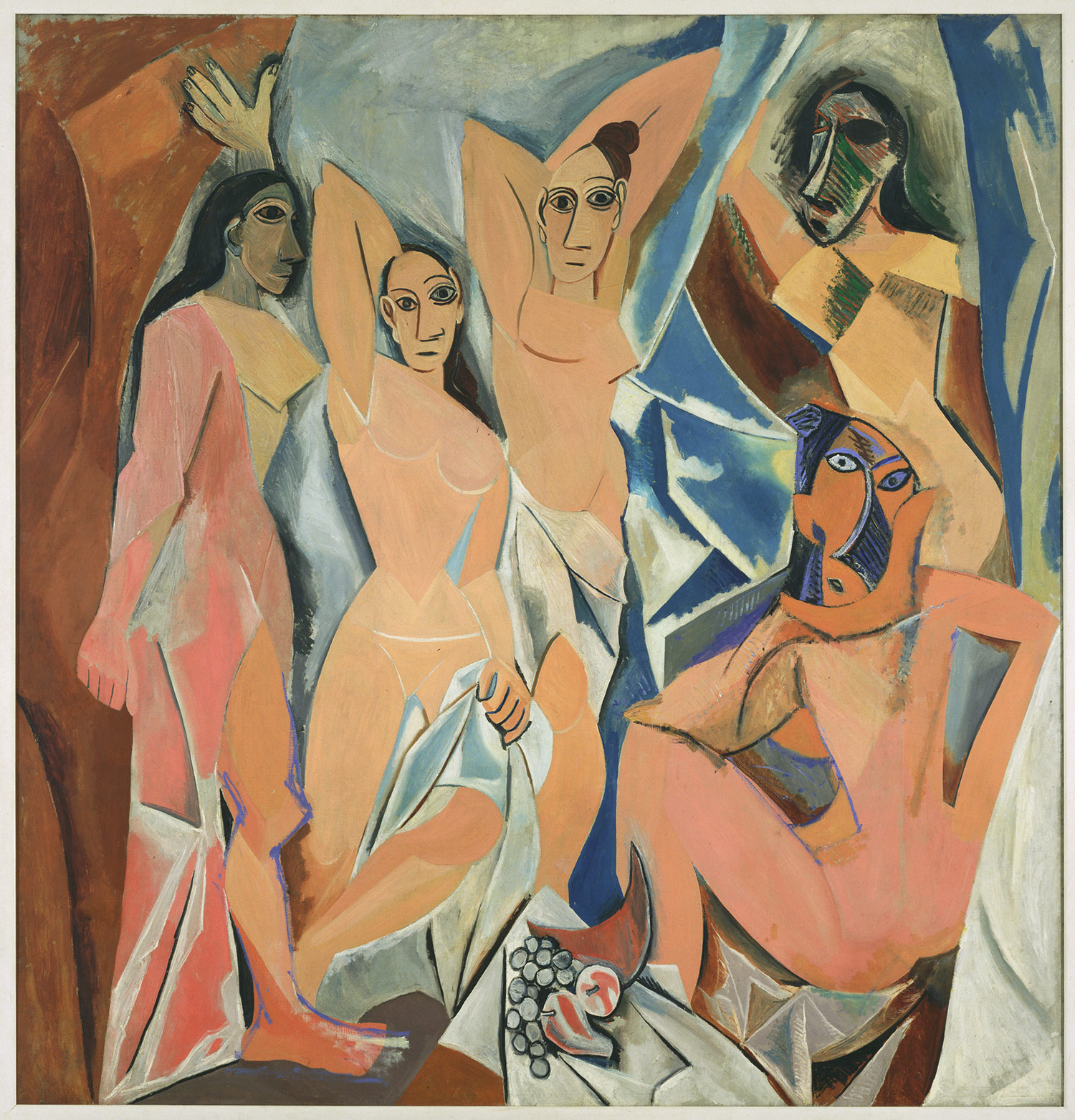
- Algunas influencias en el cubismo temprano se han vinculado al primitivismo, al arte africano, como sucede con la obra Les Demoiselles d' Avignon (Museo de Arte Moderno , Nueva York) , 1907, de Picasso.

- Los cubistas rechazaron el concepto heredado de que el arte debe copiar la naturaleza.- Los cubistas abstrajeron los objetos generando figuras geométricas.

- Utilizaron múltiples y contrastantes puntos de vista.- Cubismo analítico o "hermético" (1910-1912). Obras reducidas a una serie de planos superpuestos y facetas sobre todo en marrones, casi monocromática, grises o negros.

- Cubismo sintético (1912-1913). Iniciado por el "papier collé", que es una nueva técnica de pegado de piezas, de colores o estampadas, de papel, que conforman una composición.

- La creación de este nuevo lenguaje visual fue adoptada por otros artistas como Fernando Léger, Robert y Sonia Delaunay, Juan Gris, Roger de La Fresnaye, Marcel Duchamp, Albert Gleizes, entre otros.  - El Cubismo también ejerció una profunda influencia en la escultura y la arquitectura del siglo XX.

CUBISM


Cubism was one of the most influential visual art styles of the early twentieth century. It was created by Pablo Picasso (Spanish, 1881–1973) and Georges Braque (French, 1882–1963) in Paris between 1907 and 1914. The French art critic Louis Vauxcelles coined the term Cubism after seeing the landscapes Braque had painted in 1908 at L'Estaque in emulation of Cézanne. Vauxcelles called the geometric forms in the highly abstracted works "cubes." Other influences on early Cubism have been linked to Primitivism and non-Western sources. The stylization and distortion of Picasso's ground-breaking Les Demoiselles d'Avignon (Museum of Modern Art, New York), painted in 1907, came from African art. Picasso had first seen African art when, in May or June 1907, he visited the ethnographic museum in the Palais du Trocadéro in Paris.


The Cubist painters rejected the inherited concept that art should copy nature, or that they should adopt the traditional techniques of perspective, modeling, and foreshortening. They wanted instead to emphasize the two-dimensionality of the canvas. So they reduced and fractured objects into geometric forms, and then realigned these within a shallow, relieflike space. They also used multiple or contrasting vantage points.


Les Demoiselles d'Avignon, 1907
Pablo Picasso (Spanish, 1881–1973)
Oil on canvas; 96 x 92 in. (243.8 x 233.7 cm)
The Museum of Modern Art, New York (acquired through the Lillie P. Bliss Bequest)
Digital Image Copyright The Museum of Modern Art/Licensed by SCALA/ Art Resource, NY
Museum of Modern Art, New York

In Cubist work up to 1910, the subject of a picture was usually discernible. Although figures and objects were dissected or "analyzed" into a multitude of small facets, these were then reassembled, after a fashion, to evoke those same figures or objects. During "high" Analytic Cubism (1910–12), 
also called "hermetic," Picasso and Braque so abstracted their works that they were reduced to just a series of overlapping planes and facets mostly in near-monochromatic browns, grays, or blacks. In their work from this period, Picasso and Braque frequently combined representational motifs with letters (1999.363.63;1999.363.11). Their favorite motifs were still lifes with musical instruments, bottles, pitchers, glasses, newspapers, playing cards (1997.149.12), and the human face and figure. Landscapes were rare.

During the winter of 1912–13, Picasso executed a great number ofpapiers collés (1999.363.64). With this new technique of pasting colored or printed pieces of paper in their compositions, Picasso and Braque swept away the last vestiges of three-dimensional space (illusionism) that still remained in their "high" Analytic work. Whereas, in Analytic Cubism, the small facets of a dissected or "analyzed" object are reassembled to evoke that same object, in the shallow space of Synthetic Cubism—initiated by the papiers collés–large pieces of neutral or colored paper themselves allude to a particular object, either because they are often cut out in the desired shape or else sometimes bear a graphic element that clarifies the association.

While Picasso and Braque are credited with creating this new visual language, it was adopted and further developed by many painters, including Fernand Léger (1999.363.35), Robert and Sonia Delaunay, Juan Gris (1996.403.14), Roger de La Fresnaye (1991.397), Marcel Duchamp, Albert Gleizes, Jean Metzinger (59.86), and even Diego Rivera (49.70.51). Though primarily associated with painting, Cubism also exerted a profound influence on twentieth-century sculpture and architecture. The major Cubist sculptors were Alexander Archipenko, Raymond Duchamp-Villon, and Jacques Lipchitz.

The liberating formal concepts initiated by Cubism also had far-reaching consequences for Dada and Surrealism, as well as for all artists pursuing abstraction in Germany, Holland, Italy, England, America, and Russia.

viernes, 4 de octubre de 2013

ACTIVIDAD SOBRE EL TEXTO


IMPRESSIONISM


Claude Monet, Impression Sunrise, 1872 
(exhibited at the first Impressionist exhibition in 1874) 


Establishing their Own Exhibitions - Apart from the Salon
The group of artists who became known as the Impressionists did something ground-breaking, in addition to their sketchy, light-filled paintings. They esetablished their own exhibition - apart from the annual salon. At that time, the salon was really the only way to exhibit your work (the work was chosen by a jury).
Claude Monet, August Renoir, Edgar Degas, Berthe Morisot, Alfred Sisley, and several other artists could not afford to wait for France to accept their work. They all had experienced rejection by the Salon jury in recent years and knew waiting a whole year in between each exhibition was no longer tenable. They needed to show their work and they wanted to sell it.
So, in an attempt to get recognized outside of the official channel of the salon, these artists banded together and held their own exhibition. They pooled their money, rented a studio that belonged to the famous photographer Nadar and set a date for their first exhibition together. They called themselves the Anonymous Society of Painters, Sculptors, and Printmakers. The show opened at about the same time as the annual Salon, May 1874. The Impressionists held eight exhibitions from 1874 through 1886.

The decision was based on their frustration and their ambition to show the world their new, light-filled images. 
The impressionists regarded Manet as their inspiration and leader in their spirit of revolution, but Manet had no desire to join their cooperative venture into independent exhibitions. Manet had set up his own pavilion during the 1867 World’s Fair, but he was not interested in giving up on the Salon jury. He wanted Paris to come to him and accept him—even if he had to endure their ridicule in the process.
Monet, Renoir, Degas, and Sisley had met through classes. Berthe Morisot was a friend of both Degas and Manet (she would marry Édouard Manet’s brother Eugène by the end of 1874). She had been accepted to the Salon, but her work had become more experimental since then. Degas invited Berthe to join their risky effort. The first exhibition did not repay them monetarily but it drew the critics who decided their art was abominable. It wasn’t finished. They called it “just impressions.” (And not in a complimentary way.)
The Lack of "Finish"
Remember that the look of a J.A.D. Ingres or even a surly Delacroix had a “finished” surface. These younger artists’ completed works looked like sketches.  And not even detailed sketches but the fast, preliminary “impressions” that artists would dash off to preserve an idea of what to paint later. Normally, an artist’s “impressions” were not meant to be sold, but were meant to be aids for the memory—to take these ideas back to the studio for the masterpiece on canvas. The critics thought it was insane to sell paintings that looked like slap-dash impressions and consider these paintings works “finished.”
Landscape and Contemporary Life (not History Painting!)
Also—Courbet, Manet and the Impressionists challenged the Academy’s category codes. The Academy deemed that only “history painting” was great painting. These young Realists and Impressionists opened the door to dismantling this hierarchy of subject matter. They believed that landscapes and genres scenes were worthy and important.
Color
In their landscapes and genre scenes of contemporary life, the Impressionist artists tried to arrest a moment in their fast-paced lives by pinpointing specific atmospheric conditions—light flickering on water, moving clouds, a burst of rain. Their technique tried to capture what they saw. They painted small commas of pure color one next to another. The viewer would stand at a reasonable distance so that the eye would mix the individual marks, thus blending the colors together optically. This method created more vibrant colors than those colors mixed on a palette. Becoming a team dedicated to this new,  non-Academic painting gave them the courage to pursue the independent exhibition format—a revolutionary idea of its own.
Light
An important aspect of the Impressionist painting was the appearance of quickly shifting light on the surface. This sense of moving rapidly or quickly changing atmospheric conditions or living in a world that moves faster was also part of the Impressionist’s criteria. They wanted to create an art that seemed modern: about contemporary life, about the fast pace of contemporary life, and about the sensation of seeing light change incessantly in the landscape. They painted outdoors (en plein air) to capture the appearance of the light as it really flickered and faded while they worked.

Mary Cassatt was an American who met Edgar Degas and was invited to join the group as they continued to mount independent exhibitions. By the 1880s, the Impressionist accepted the name the critics gave them. The American Mary Cassatt began to exhibition with the Impressionists in 1877.

For a very long time, the French refused to find the work worthy of praise. The Americans and other non-French collectors did. For this reason, the US and other foreign collections own most of the Impressionist art. (The Metropolitan Museum of Art owns a good portion of the Havermayer Collection. Louisine Havermayer knew Mary Cassatt, who advised Louisine when she visited Paris.)

Text by Beth Gersh-Nesic